Have You Ever Wondered What Happens to an Old Book?
Have you ever picked up an old book and wondered where it has been?
Perhaps it has a worn leather cover, yellowed pages, or a handwritten inscription inside.
Maybe it has been passed down through several generations.
Think about that for a moment.
How many hands have held that book? How many people have turned its pages? What stories could it tell about the places it has traveled and the people who treasured it?
Now imagine that the binding begins to fall apart.
Pages become loose. The cover deteriorates. Years of handling and exposure begin taking their toll.
Is that the end of its journey?
Not necessarily!
There’s an extraordinary craft devoted to preserving these treasures, and I was fortunate enough to discover it firsthand while I was still in high school.
It’s called traditional bookbinding.
And my experience introduced me to much more than the art of repairing books.
It introduced me to a remarkable family.
An Unexpected Classroom
Back in 1987 and 1988, I attended a technical high school in Sparta, New Jersey, where I studied graphic arts.
Our training covered just about every aspect of traditional printing.
We learned to operate, maintain, and repair printing presses. We studied photography, film developing, stripping, platemaking, and the many processes involved in turning images and words into printed materials.
But one of my favorite parts of the program happened outside the classroom.
As part of our vocational education, we could spend half the school day working at a local business and receive school credits for the experience.
My best friend Ivan and I were fortunate enough to work at a place called Turul Bookbindery in Jefferson Township, New Jersey.
Now, let’s remember something important.
We were teenagers.
Getting out of school halfway through the day was already a pretty good deal!
But what made the experience special was the place itself.
Turul wasn’t an ordinary print shop.
It was a family-owned custom bookbinding business where craftsmen practiced techniques that had been passed down through generations.
They worked on rare books, old family Bibles, historical volumes, specialty bindings, and other treasured items.
And nearly everything involved careful, hands-on craftsmanship.
For two high school students interested in graphic arts, it was an extraordinary place to spend an afternoon.
A Family Tradition That Crossed an Ocean
While exploring the history of Turul many years later, I discovered just how remarkable this family business really was.
Its story began in 1932 in Sopron, Hungary.
A young craftsman named Lajos Gregorencsics, also known as Louis, had learned the trade of bookbinding. Together with his wife, Margaret, he established a bindery.
But the family’s journey would take some extraordinary turns.
Europe experienced war, occupation, and political upheaval. Following the Hungarian Revolution of 1956, the Gregorencsics family eventually left their homeland and traveled to America.
They had to begin again.
After settling in New York, the family worked toward reopening its business.
This time, it would be called Turul Bookbindery.
The name Turul comes from a mythical bird associated with Hungarian history and tradition, often regarded as a symbol of national identity and freedom.
What an appropriate name for a family carrying its heritage into an unfamiliar country.
In the early 1970s, the business moved to New Jersey. By 1975, the family had established a purpose-built bookbinding workshop in Jefferson Township.
That’s where Ivan and I would eventually find ourselves, completely unaware of the extraordinary journey that had brought this family into our lives.
And at the center of some of my fondest memories was a woman we simply called Grandma.
Grandma Margaret
Her name was Margaret Gregorencsics.
But to Ivan and me, she was Grandma.
I remember her singing while she worked.

She joked with us, told stories, and treated us like members of the family.
Her English was sometimes difficult for us to understand. I can remember occasions when she would ask me to help with something, and I couldn’t quite figure out what she needed.
Sometimes her granddaughter Margit, who was my boss, would have to help translate.
But communication was never really a problem when it came to feeling welcome.
Grandma Margaret had a way of making us feel at home.
And when she sat down to work, something wonderful happened.
I watched those experienced hands sewing, cutting, gluing, and carefully working with materials that most people would never think of using.
She seemed capable of doing just about everything involved in the craft.
The work required extraordinary patience.
A single book might spend days or even weeks in the shop as it moved through the various stages of restoration.
There was no rushing it.
Every piece mattered.
And watching someone carefully rebuild a book that might have been around for generations was fascinating.
Taking a Book Apart to Save It
Here’s something that might surprise you.
Sometimes, to preserve a damaged book, a bookbinder must carefully take it apart.
Imagine that!
An old book arrives with a deteriorating cover, loose pages, and a binding that has begun to fail.
The craftsman first examines its condition.
How was it originally constructed?
What materials were used?
Which pieces can be preserved, and which need attention?
Different books require different approaches, and valuable historical objects often call for minimal intervention rather than complete rebuilding.
But when rebinding is appropriate, the work can be extraordinary.
The old cover may be carefully separated. Damaged stitching may be removed. Sections of pages can be examined individually.
Those folded groups of pages are called signatures.
A signature is created when a large printed sheet is folded into a group of pages. Several signatures can then be sewn together to form the body of a book.
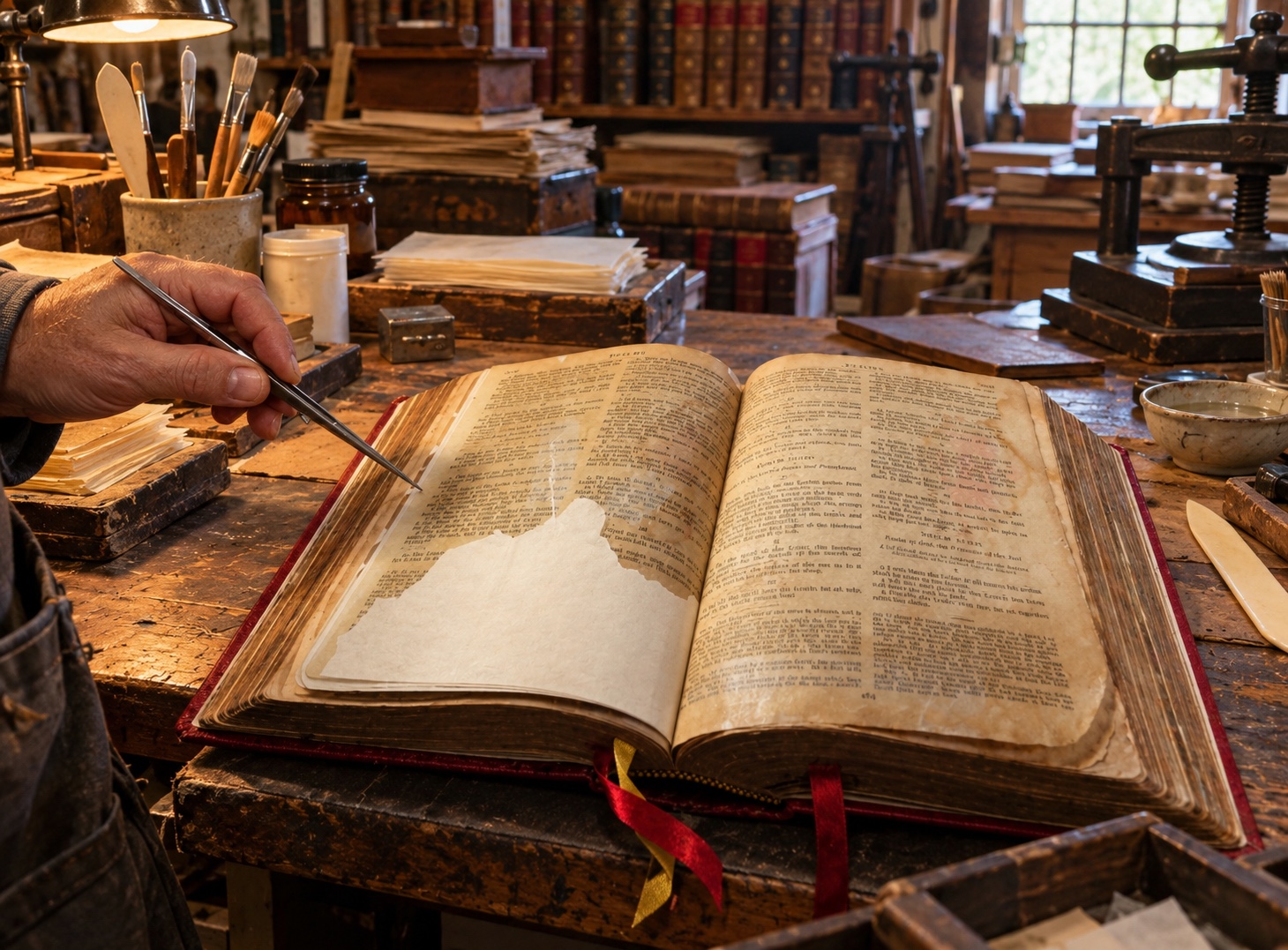
If pages have torn, a conservator may repair them using carefully selected thin paper and a suitable adhesive.
Japanese tissue is frequently used for these repairs because it can provide strength without adding excessive thickness.
Then comes the sewing.
Using a sewing frame or other traditional methods, the signatures are joined together with thread.
Once the book’s pages are secure, the spine and covers can be repaired or reconstructed as appropriate.
Leather, cloth, board, adhesives, and decorative materials may all play a role.
Finally, the book is pressed, shaped, and finished.
And throughout the process, each stage requires careful attention.
At Turul, I remember seeing these procedures performed by hand.
The large presses, the specialized tools, the sewing equipment, the cutting machinery—it was all part of an incredible craft.
But what fascinated me most was watching an old book being dismantled, piece by piece, and then carefully brought back together.
Not simply repaired.
Preserved for another generation.
The Beauty of Gold Lettering
Another part of the shop that fascinated me was the machinery used to produce lettering.
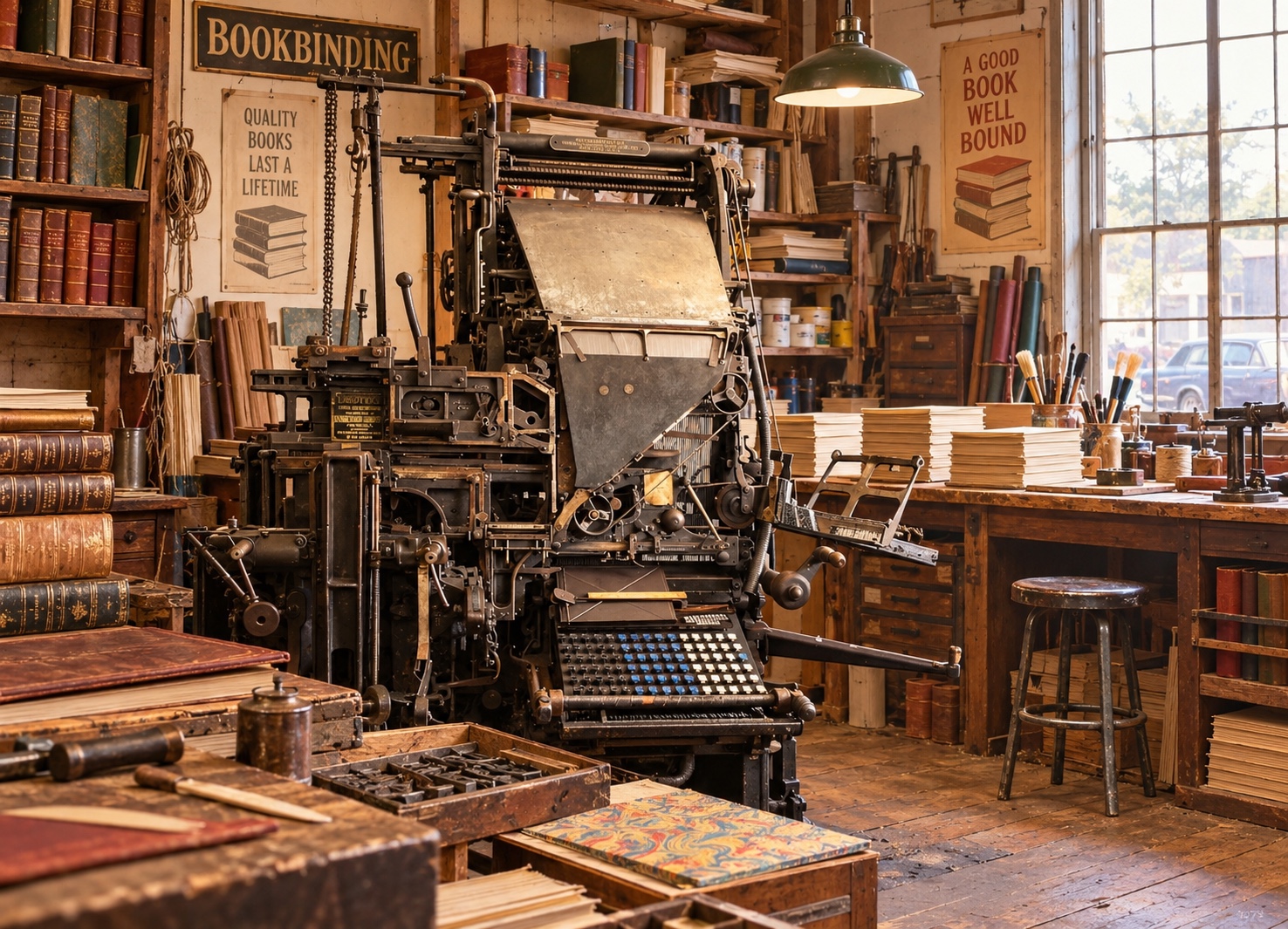
I learned to operate an enormous old typesetting machine.
It stood tall and had a keyboard that reminded me of a giant typewriter.
The machine used molten lead alloy to cast metal printing type.
These machines were called Linotypes, and they represented an important chapter in printing history.
Unlike arranging every letter individually, a Linotype machine could cast an entire line of type as one piece of metal, called a slug.
Imagine that!
A keyboard controlling an elaborate mechanical process that produced solid metal lettering.
In the bindery, I remember creating lettering while the experienced craftspeople handled the more delicate finishing work.
One of the beautiful finishing techniques involved arranging metal type in a holder and transferring decorative lettering onto book covers or spines.
Gold and other metallic finishes were especially memorable.
In traditional finishing, heat, pressure, and specialized foil—or, in some historic methods, genuine gold leaf—can create elegant lettering and ornamentation.
There’s something beautiful about an old leather-bound book with a carefully finished gold title along its spine.
It’s more than decoration.
It’s craftsmanship.
And at Turul, those finishing details were treated as part of the book’s identity.
More Than Books
The shop wasn’t limited to restoring rare books.
Turul also produced custom bindings and worked with materials intended to preserve and display treasured collections.
I remember projects involving collectible stamps, coins, baseball cards, and other keepsakes.
That makes sense when you think about it.
Whether someone is protecting an old family Bible, organizing a collection, or preserving a historical record, the underlying goal is similar.
They’re caring for something they believe deserves to survive.
And traditional bookbinders bring a special combination of mechanical skill, artistic judgment, and attention to detail to that work.
The Craft That Refuses to Disappear
As printing technology changed, many of the machines and processes I learned about in high school became less common.
Today, we can create documents, print photographs, and even publish books using technology that would have seemed extraordinary in the 1980s.
But traditional hand bookbinding has never entirely disappeared.
There are still skilled craftspeople repairing family heirlooms, preserving historical volumes, and creating beautiful custom bindings.
And here’s a discovery I was delighted to make while researching this article.
Turul Bookbindery is still in business!
The family’s tradition continued beyond those afternoons Ivan and I spent in the shop.
After decades in New Jersey, Turul eventually relocated to Myrtle Beach, South Carolina, where the business continues offering bookbinding and restoration services.
A craft that began with one family’s workshop in Hungary has survived international upheaval, immigration, generations of technological change, and the passing of time.
That’s quite a journey!
And isn’t that what preserving something is really about?
Helping it continue its story.
What I Remember Most
Looking back, I’m grateful for the opportunity to have witnessed such extraordinary craftsmanship.
But there’s something interesting I’ve discovered about my own memories.
After nearly forty years, it isn’t the old machinery or the rare books that comes to mind first.
It’s the people.
I remember working alongside Ivan, my best friend since kindergarten. We still keep in touch today.
I remember Margit and the family.
And I especially remember Grandma Margaret, singing, joking, telling stories, and asking us for help.
We weren’t master bookbinders.
We handled maintenance, odd jobs, and whatever extra hands were needed around the shop.
Much of our education came from simply watching and learning.
And although it was technically a job, it rarely felt like work.
We looked forward to going there.
I suppose that’s what happens when people make you feel like part of their family.
The craftsmen at Turul spent their days preserving precious books.
But without realizing it, they were also creating memories that would stay with two teenage boys for the rest of their lives.
And those memories have become stories worth preserving, too.
Join the Discovery
Here’s something I’d love for you to try.
Find an old book somewhere in your home.
It doesn’t have to be rare or valuable.
Maybe it’s a family Bible, a cookbook that belonged to your grandmother, an old schoolbook, or a novel that’s been sitting on a shelf for decades.
Take a few minutes to examine it.
Look at the binding.
Notice how the pages are attached.
Examine the cover, the lettering, and any signs of age.
Open it carefully and look for inscriptions, handwritten notes, or names.
Then ask yourself:
Where has this book been, and whose hands have held it before mine?
You might discover something fascinating.
And if you have an old book that’s beginning to deteriorate, consider asking a qualified bookbinder or conservator about preserving it. Avoid attempting to dismantle valuable or historically important books yourself.
Sometimes the greatest discoveries aren’t hidden in the words of a book.
They’re hidden in the journey the book has taken.
Share your discovery →Behind the Discovery
During the 1987–1988 school year, my best friend Ivan and I worked at Turul Bookbindery in Jefferson Township, New Jersey, as part of our high school’s vocational graphic arts program.
I never forgot the fascinating machinery, the rare books, or watching traditional bookbinding performed by hand.
But my fondest memories were of the family who welcomed us into their workshop, particularly Grandma Margaret, who was always singing, joking, and telling stories.
Researching Turul’s history all these years later allowed me to rediscover that remarkable family and learn more about the journey that brought their craft from Hungary to America.
I started exploring how old books are preserved.
And somewhere along the way, I rediscovered a wonderful chapter of my own life.
What did you discover today?
Discover the Journey.