This story shares a personal experience with mindfulness and meditation for exploration and reflection. It is not professional advice, treatment, or instruction.
I thought being present was a saying.
For most of my life, when I heard someone talk about living in the present moment, I thought I understood what they meant.
Be happy you're here.
Be grateful.
Enjoy your life.
Appreciate every minute.
It was something you told yourself when you were sad, angry, resentful, worried, or struggling.
Live in the moment.
To me, it was almost a way of consciously trying to change an emotion.
If I was angry, maybe I shouldn't be angry.
If I was sad, I should think about everything I had to be grateful for.
If I was worried about tomorrow, I should remind myself to enjoy today.
It sounded good.
I just didn't understand yet that there might be considerably more to it.
I Thought Meditation Meant Going Somewhere
I had heard for years that meditation could help with mindfulness and being present.
There was only one problem.
I didn't really understand meditation either.
I thought meditation meant closing your eyes and somehow going somewhere else.
Maybe reaching another level of consciousness. Maybe having some kind of transcendent or almost out-of-body experience.
So I tried.
For years.
This was before you could instantly pull up thousands of videos and hear fifty different people explain something fifty different ways.
I read books.
Often, I didn't understand what I was reading.
I'd try.
Nothing remarkable would happen.
I'd get discouraged.
The pathway I happened to encounter emphasized the mystical and transcendent side of meditation. I didn't know there were many other approaches.
Then I encountered the same word somewhere I hadn't expected it.
People talked about meditating on words.
That confused me.
How do you travel somewhere else while you're thinking about words?
So eventually I stopped trying to figure out how to meditate and started trying to understand something much simpler:
What does meditation actually mean?
Maybe I Had Been Asking the Wrong Question
Something started clicking.
I began understanding meditation, in one form, as deliberately directing attention toward something.
The meditation was the activity.
The focus was the subject.
I could focus on words—not merely read them, but consider what they meant to me, what they might mean to someone else, and how they related to my situation.
I could focus on breathing.
A sound.
A sensation.
Something happening inside me.
And suddenly meditation didn't necessarily mean leaving where I was.
Some forms seemed to involve doing almost exactly the opposite.
Paying closer attention to what was already here.
Modern research makes an important distinction that I didn't know then: meditation doesn't describe one single practice. It encompasses many different approaches. One commonly studied form, focused-attention meditation, involves deliberately attending to something such as the breath and noticing when attention wanders before returning it. Another, often called open monitoring, involves noticing experiences—including thoughts, sensations and emotions—as they arise without selecting one particular object of attention.
I certainly didn't know those names.
I was just beginning to understand that meditation was much bigger than I had imagined.
Then Something Happened

One of the early exercises I learned was intended to help with anxiety.
I focused on my breathing.
I was directed to notice things that existed right then through my senses.
What could I hear?
What could I feel?
What was actually happening at that moment?
Immediately afterward, I was asked a question.
Not what I was anxious about before the exercise.
Not what I might become anxious about afterward.
What were you anxious about during it?
I couldn't answer.
I couldn't identify anything.
The explanation I was given was that while my attention was occupied with the present experience, those anxious thoughts weren't occupying my awareness.
Was that explanation scientifically complete?
I didn't know then, and I wouldn't claim that it is now.
Research into mindfulness and anxiety is considerably more complicated than my experience that day. Studies suggest mindfulness-based approaches can help some people with anxiety, although results vary depending on what they're compared with, and researchers continue studying exactly how these practices work.
But something much simpler mattered to me:
My experience tracked.
For that brief period, I experienced something different.
And I wanted to understand it.
Knowing About It Wasn't the Same as Living It
I wish I could say I understood mindfulness after that.
I didn't.
For years, meditation was mostly something I remembered after stressful situations.
Something would happen.
I'd react.
My mind would run on autopilot.
Then eventually I'd remember:
Oh yeah. I have this tool.
I'd meditate.
I'd focus on my breathing.
I'd practice noticing my senses.
Then I'd go back to life.
I had learned an exercise.
I hadn't learned how to connect it to everything else.
I had learned how to meditate, but I hadn't learned how to remember to be mindful.
Eventually, through guidance, practice, questioning and making connections for myself, that began to change.
Meditation stopped being something completely separate from ordinary life.
I began noticing thoughts.
Emotions.
Physical sensations.
Reactions.
Assumptions.
Words.
And perhaps most importantly, I started noticing when I wasn't noticing.
Researchers studying focused-attention meditation actually describe something similar as part of the attentional process: attention wanders, the wandering is recognized, and attention is redirected. Open-monitoring practices broaden that awareness to what is occurring from moment to moment, including sensory, cognitive and emotional experience.
That sounded remarkably familiar.
Autopilot

Recently, I was anticipating a difficult conversation with someone important in my life.
Normally, my mind could have started writing the conversation before it happened.
They'll probably say this.
Then I'll say that.
But what if they bring up this?
Pretty soon I've created an entire conversation involving another person who isn't even there.
And then I can have emotional reactions to a conversation that hasn't happened.
This time, I tried something different.
Before the interaction, I meditated.
But I didn't rehearse.
I didn't strategize every possible response.
My intention was simply to stay present during the actual conversation—and notice when my mind slipped back onto autopilot.
If it did, I could return.
That gave me an opportunity to hear what the other person was actually saying, rather than only hearing it through the conversation I had already constructed in my head.
But I've discovered something else too.
Being mindful doesn't mean eliminating the emotion.
For me, it's almost the opposite.
It gives me an opportunity to notice it.
I'm angry.
I'm hurt.
I'm anxious.
What am I feeling?
Where am I feeling it?
What's actually happening?
Then I have an opportunity to process that before deciding what I want to do.
Mindfulness, as defined in biomedical literature, includes moment-to-moment awareness of experience without judgment. Researchers studying meditation have likewise examined how attention and monitoring may relate to emotional processing, while cautioning that meditation includes many different practices and that their effects shouldn't all be treated as interchangeable.
For me, that distinction has become enormously important.
“You Can't Talk to Me Like That”
I've even started noticing the words I use.
Should.
Shouldn't.
Can't.
Would.
Sometimes I catch one and ask myself:
What's the evidence for that statement?
Suppose someone says something to me that I find disrespectful.
My automatic reaction might be:
“You can't talk to me like that.”
But wait.
Can't they?
They just did.
That doesn't mean I have to like it.
It doesn't mean I have to accept mistreatment.
It doesn't mean I can't establish a boundary, leave the conversation, disagree, or decide that I don't want to be treated that way.
It means their behavior and my next action aren't necessarily the same event.
They get to choose what they say.
I get to choose what I do with what was said.
And presence gives me something extraordinarily valuable between those two things:
An opportunity to notice.
It doesn't decide what I should do.
It gives me an opportunity to see what's happening before I decide what to do.
With My Eyes Open

Something else happened along the way.
Mindfulness started following me outside.
Onto a beach.
Into the woods.
Up a mountain trail.
Beside a waterfall.
Onto a boat with a fly rod in my hand.
These are some of the places where Discover the Journey and mindfulness intersect for me personally.
When I'm present during an adventure, I'm not only trying to reach the destination.
I can notice the temperature.
The smell of the woods.
The sound of water.
The feeling of sand.
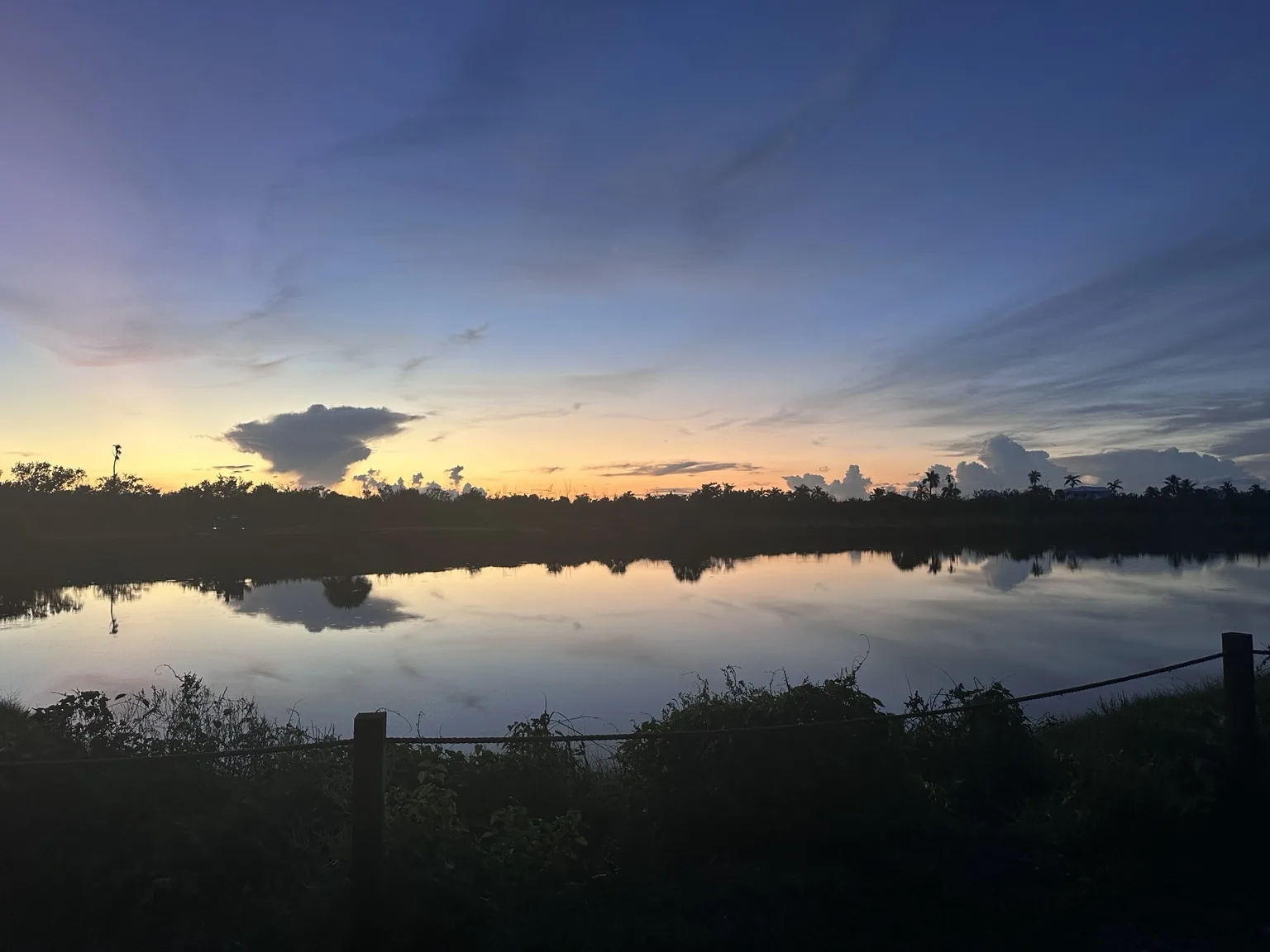
The light changing across the sky.
The movement at the edge of the water.
Something tiny beside a trail that I might otherwise have walked straight past.
Mindfulness doesn't necessarily make the sunset more beautiful.
It may simply help me notice more of what was already there.
There's a wonderful irony in that.
When I first began trying to meditate, I thought I needed to close my eyes and go somewhere else.
After all these years, some of what I've discovered has helped me open them.
I Can Feel a Smile
Today, mindfulness means more to me than simply being aware that I'm in the present moment.
It's becoming aware of what is happening in that moment.
Outside me.
And inside me.
And I have absolutely no idea how big this gets.
I'm not an expert in meditation.
I'm not an expert in mindfulness.
I'm not an authority on any particular philosophy or practice.
There are traditions, practices, theories and experiences I haven't begun to explore.
And that's exciting.
Because this has been life-changing for me, and instead of making me think I've found the answer, it has made me wonder what other people have experienced that I don't even know exists.
Recently, I noticed something extraordinarily ordinary.
I smiled.
But this time, I noticed more than the fact that my face was smiling.
I could feel something happening in my body.
I could connect the physical expression with an internal feeling in a way I don't remember experiencing before.
I didn't have a technical name for it.
So I gave it my own.
I can feel a smile.
Maybe someone else has experienced that completely differently.
Maybe someone has a name for it.
Maybe another person's path toward understanding themselves looks nothing like mine.
I want to hear about it.
Because I'm discovering that mindfulness isn't giving me fewer questions.
It's teaching me to notice more of them.
And apparently, sometimes discovery isn't finding something new somewhere out in the world.
Sometimes it's noticing something that's been happening inside you all along.
I can feel a smile. 🧭
Join the Discovery
Here’s a small discovery challenge: notice one ordinary moment you might usually rush through.
When you are somewhere safe to pause, pay attention to a sound, a physical sensation, or a feeling. You don’t have to change it or make the moment special. Simply notice what is already happening.
Have you ever experienced something like feeling a smile? Has becoming present changed the way you experience an ordinary day? I’d love to hear what you’ve discovered.
Share your discovery →Behind the Discovery
This story comes from my ongoing exploration of meditation, mindfulness, and the difference between knowing about being present and remembering to practice it.
The conversations, questions, outdoor experiences, and moment of noticing a smile are parts of my own journey. I’m still learning, and I’m sharing the experience rather than claiming to have all the answers.
What did you discover today?
Discover the Journey.