Growing up, I was surrounded by people who knew how to make things.
My grandfather was the head of our household, and if something needed building, he usually built it himself.
Need a chair? Build one.
A bookshelf? Make it.
A knife holder? No problem!
He even built a house!
But our family wasn’t unusual in that respect. For many families of his generation, making things, repairing what was broken, and saving useful materials were simply part of everyday life.
Nobody called it farmhouse, cabin, or rustic design.
It was just home.
Years later, I would discover something about those simple handmade creations that completely changed the way I approached my own projects.
They didn’t have to look perfect to be beautiful.
And believe me, that realization took a lot of pressure off!
Lessons from My Grandfather
My grandfather was a chemical and mechanical engineer who worked as a city’s chief engineer, overseeing water systems, pump houses, and wastewater facilities.
He was an incredibly analytical man.
He could visualize practically anything he wanted to build. Rarely did I see him sketch out a project. Somehow, he seemed to have the whole thing planned in his head!
I’m quite different.
I like to draw things out and develop a plan before I start building.
But what fascinated me most was the way he taught us.
He didn’t want us simply standing around watching.
He insisted that we actually do the work while he supervised.
I was probably only seven years old when I first used a circular saw under his supervision. Looking back, that was remarkably young for such a dangerous tool, and certainly not something I’d recommend for children today.
But I remember his lessons vividly.
He could turn something as simple as hammering a nail into an entire dissertation!
How to hold the hammer. The proper angle of the nail. The amount of force needed to drive it.
Three or four strikes, he’d say. That was productive!
And his planning was incredible.
He could announce that we were building a section of his barn and estimate that the work should require no more than 600 nails.
Six hundred nails!
I was just a kid, but he knew exactly what he wanted to accomplish.
Looking back, I realize he was teaching us something far more important than woodworking.
He was teaching us to understand materials, think through problems, and take pride in making something useful.
And there’s a distinction I didn’t fully appreciate until years later.
Good craftsmanship and visual perfection aren’t necessarily the same thing.
When Everything Had to Look Store-Bought
As I began making things myself, I developed an expectation that many people probably recognize.
I wanted everything to look store-bought!
Straight edges. Smooth surfaces. Perfect finishes.
No scratches, dents, uneven coloring, or visible mistakes.
If something didn’t turn out exactly as I imagined, I felt disappointed.
I’d spend extra time trying to correct little imperfections that probably didn’t matter very much.
But eventually, something dawned on me.
What if those imperfections weren’t mistakes?
What if they were actually part of the design?
That’s when I began discovering the world of rustic furniture.
Farmhouse, cabin, lodge, country, primitive, industrial, and coastal rustic styles.
They weren’t all the same, but many shared an appreciation for natural materials, weathered surfaces, handmade details, and the character that comes with age.
And suddenly, I started seeing things differently.
Knots in the wood weren’t necessarily defects.
Old nail holes could tell a story.
Weathered metal could add character.
Uneven coloring could make a piece more interesting.
The imperfections hadn’t disappeared.
The pressure to eliminate them had!
Rustic Doesn’t Mean Careless
Now, here’s something important.
Discovering rustic design didn’t make me stop appreciating beautifully finished furniture or detailed craftsmanship.
I still enjoy creating things that require precision, careful measurements, and a polished appearance.
It depends on what I’m making and who I’m making it for.
But rustic design gave me another creative option.
A simple wooden shelf doesn’t need elaborate trim or expensive materials to be attractive.
It needs to be sturdy, useful, and built to last.
A handmade bench can have knots, visible grain, and a few tool marks while still being carefully constructed.
There’s a difference between an imperfection that adds character and a defect that makes something unsafe.
A slightly uneven stain? Character.
A weathered surface? Beautiful.
A loose joint or unstable leg?
That’s something to fix!
Rustic isn’t an excuse for poor workmanship. It’s a style that allows the natural character of materials to become part of the finished piece.
And for someone just learning to build things, that’s wonderfully liberating.
One Person’s Scrap Is Another Person’s Project
Once I began embracing rustic design, I discovered another benefit.
It could save me a lot of money!
One of my favorite ways to find materials is simply asking contractors whether they have any scrap lumber they’re willing to part with.
You’d be surprised at what gets discarded during construction.
Short boards, leftover pieces of lumber, and odd-sized cutoffs might not be useful for a contractor’s next job.
But they can be perfect for a small handmade project.
And here’s something I discovered.
Sometimes contractors appreciate someone taking the scraps because it can reduce the amount of material they need to dispose of.
Everybody benefits!
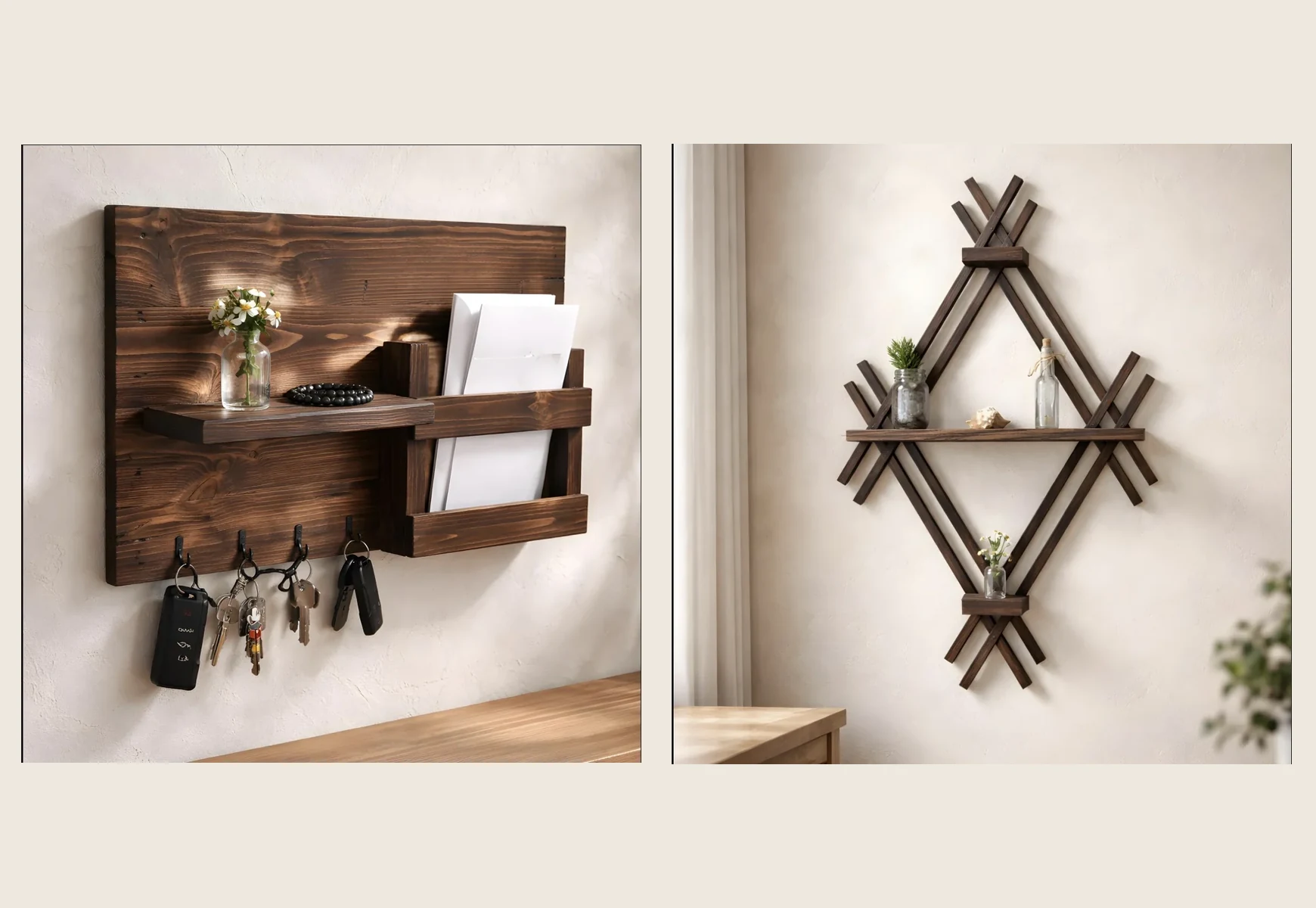
In fact, the wall shelves throughout my home are made from scrap wood.
I purchase the hardware needed to mount them securely, but the wood itself comes from materials that might otherwise have been thrown away.
There’s something incredibly satisfying about that.
I’m creating something useful, saving money, and giving discarded materials another purpose.
Of course, not every piece of scrap is suitable. I look for sound, clean wood and avoid questionable painted, chemically treated, or contaminated materials, particularly if I plan to use heat or create sawdust.
But with a little care and imagination, ordinary scraps can become extraordinary little projects.
Bringing the Grain to Life
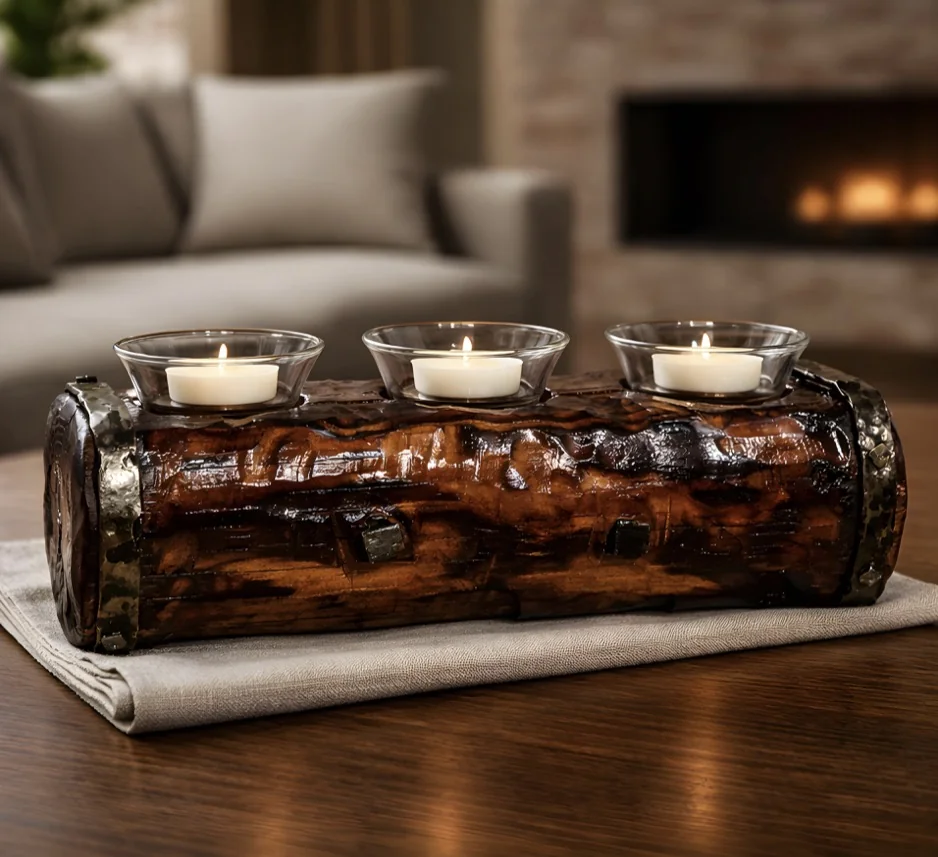
One of my favorite ways to give wood a rustic appearance is by lightly scorching the surface with a torch.
I’m not trying to turn the wood completely black.
I just want enough heat to darken parts of the grain and create contrast.
Then, after preparing the surface, I apply stain and a compatible protective finish.
The transformation can be amazing!
An ordinary piece of lumber suddenly develops beautiful patterns and a warmth that makes the natural grain stand out.
And I don’t need an expensive species of wood to create an interesting finish.
This technique is decorative rather than a guarantee of weatherproofing. It requires proper fire precautions, a suitable outdoor work area, and clean, untreated wood. A fire extinguisher should be nearby, and the material must be completely cool before any finishing product is applied.
I also like experimenting with different stains, finishes, and hardware to see how each one changes the personality of the piece.
That’s part of the discovery!
No two boards are exactly alike, and sometimes the finished result surprises me.
Treasures in a Box of Junk
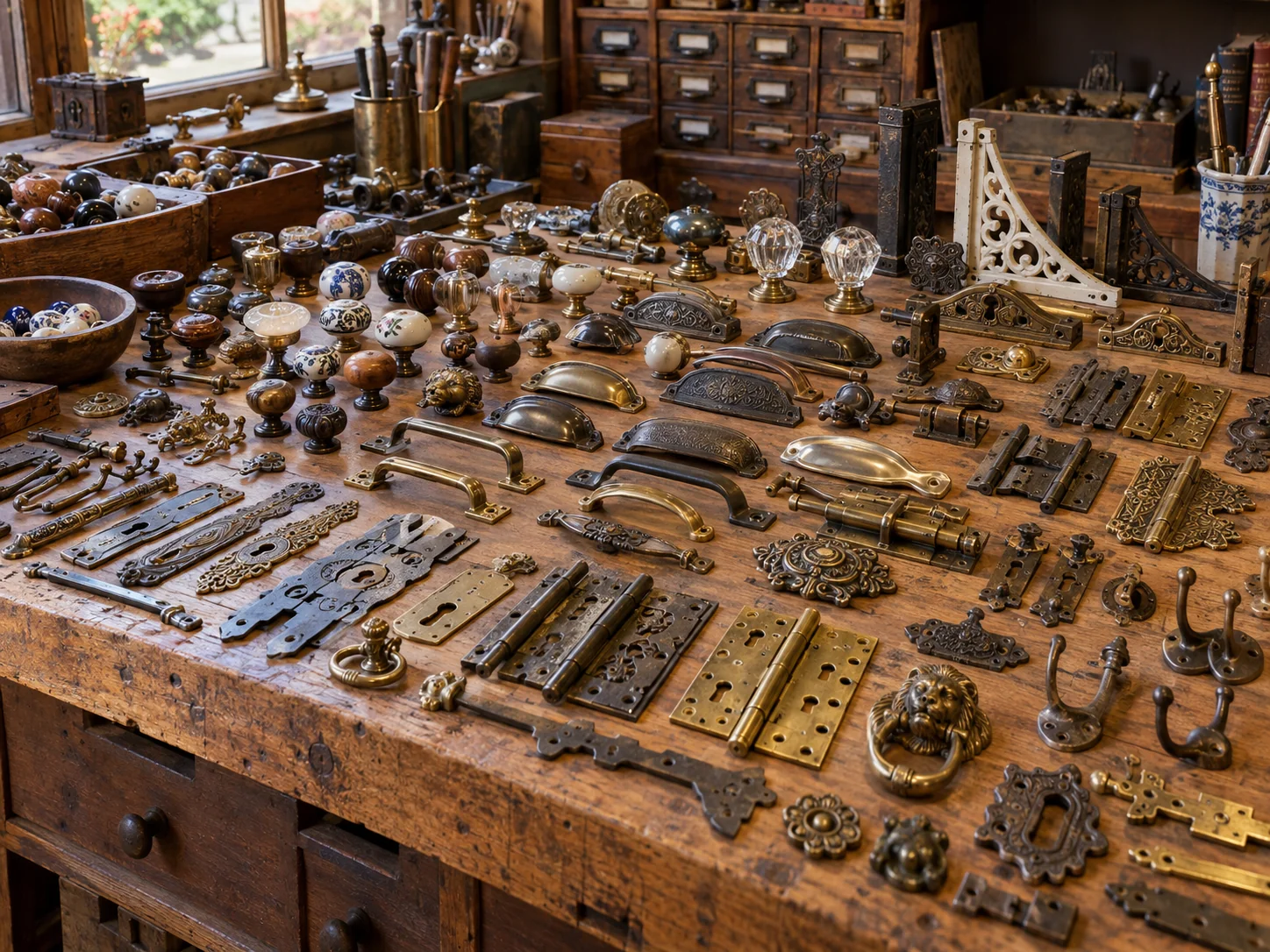
Another habit I’ve developed is saving old hardware.
If I see a piece of furniture or decor that’s headed for disposal, I might remove the handles, hinges, brackets, or other useful fittings before it goes away.
And I love garage sales!
Sometimes the best discoveries are hiding in a dusty box filled with miscellaneous parts.
Old drawer pulls, screws, hinges, handles, and little pieces of metal that don’t seem to belong to anything.
To someone else, it might look like junk.
But I look a little closer.
What if that box was somebody’s father’s hardware collection?
Maybe he saved those pieces over years of repairing things, building furniture, and taking care of his home.
And now they’re sitting in a box at a garage sale!
I love imagining the possibilities.
An old drawer pull might look perfect on a rustic cabinet.
A decorative hinge could add character to a wooden storage chest.
A metal fitting might become part of a project I haven’t even dreamed up yet.
And I’ll admit something.
I collect just about all of it!
I’ve got bags and boxes filled with hardware and miscellaneous parts.
Do I always know what I’m going to use them for?
Nope!
But sooner or later, I might find myself working on something and realize that an old piece I’ve saved is exactly what I need.
You don’t always need to buy something new to make something new.
Sometimes you just need to recognize the possibilities in what you already have.
For anything that carries weight or serves an important safety function, I still use properly rated hardware and appropriate fasteners. But for decorative details, salvaged pieces can add wonderful character.
A Good Place to Begin
If you’ve ever wanted to try woodworking but felt intimidated by the thought of making everything perfect, rustic projects can be a wonderful place to start.
You don’t need to begin with an expensive dining room table or a complicated piece of furniture.
Try something simple.
A small wall shelf.
A wooden sign.
A rustic picture frame.
Or perhaps a little storage box.
You can experiment with inexpensive lumber, natural wood grain, simple finishes, and decorative hardware.
Focus on learning how to measure, cut, assemble, and finish your project correctly.
Use suitable tools, follow their safety instructions, and make sure the finished piece is sturdy and reliable.
Then give yourself permission to enjoy its character.
A knot in the wood doesn’t mean you’ve failed.
A little variation in the stain doesn’t necessarily ruin the project.
And a handmade piece doesn’t need to resemble something manufactured in a factory.
In fact, that’s part of its charm!
There are wonderful examples of rustic craftsmanship everywhere, from farmhouse furniture to cabin decor and industrial-style shelving.
Each approach offers something different.
And that’s what makes creating things so enjoyable.
There’s always another technique to try, another material to experiment with, and another discovery waiting in the workshop.
The Freedom to Make Something
Looking back, I think my grandfather would have appreciated this way of thinking.
He understood that the purpose of making something was often quite simple.
You needed something.
So you made it.
And you made it to last.
His engineering knowledge and attention to detail were extraordinary, but the everyday things he built were still practical objects meant to be used.
Over time, I’ve come to appreciate the beauty in that simplicity.
I’ve also learned that different projects call for different artistic approaches.
Sometimes I want a polished, carefully refined piece.
Other times, I want something rustic, rugged, and filled with natural character.
Neither is better than the other.
They’re simply different ways of creating.
The real discovery was realizing that I had the freedom to choose.
I didn’t have to make every project look store-bought.
I could experiment, make something useful, appreciate its imperfections, and enjoy the process.
And sometimes, the most beautiful thing about a handmade project isn’t the way it looks.
It’s the story of how it came to be.
Join the Discovery
Have you ever wanted to build something but worried that it wouldn’t turn out perfectly?
Maybe you’ve looked at an old piece of furniture and wondered whether it was worth saving.
Or perhaps you’ve discovered a clever way to turn inexpensive or discarded materials into something useful.
I’d love to hear about it!
What’s your favorite money-saving DIY trick?
Have you ever rescued something that someone else was about to throw away?
And here’s a challenge.
Look around your home, garage, or workshop. Is there something you’ve overlooked that could become your next project?
Sometimes all it takes is seeing an ordinary object from a different perspective.
Behind the Discovery
My appreciation for handmade craftsmanship began when I was very young.
My grandfather was an extraordinary builder and engineer who believed that we should learn by doing.
He taught us to understand our tools, think carefully about our work, and take pride in making things that were useful and reliable.
But as I developed my own creative interests, I became increasingly focused on making everything look professionally manufactured.
It took discovering rustic design to realize that not every project needed that kind of finish.
I began appreciating natural wood grain, weathered materials, salvaged hardware, and the character that comes with handmade objects.
That change in perspective lifted a tremendous amount of pressure.
Today, I still enjoy detailed craftsmanship, but I also love taking a piece of discarded lumber and turning it into something useful.
And every time I search through one of my boxes of old hardware, I remember that a little creativity can give forgotten things an entirely new purpose.
Maybe that’s one of the greatest lessons I’ve carried forward from my grandfather.
Making something doesn’t always have to be complicated.
Sometimes it just needs to be simple, sturdy, useful, and made with care.
No apologies for the imperfections!
What did you discover today?
Discover the Journey.
Photographs and illustrative imagery supplied or approved for this Discovery Article.