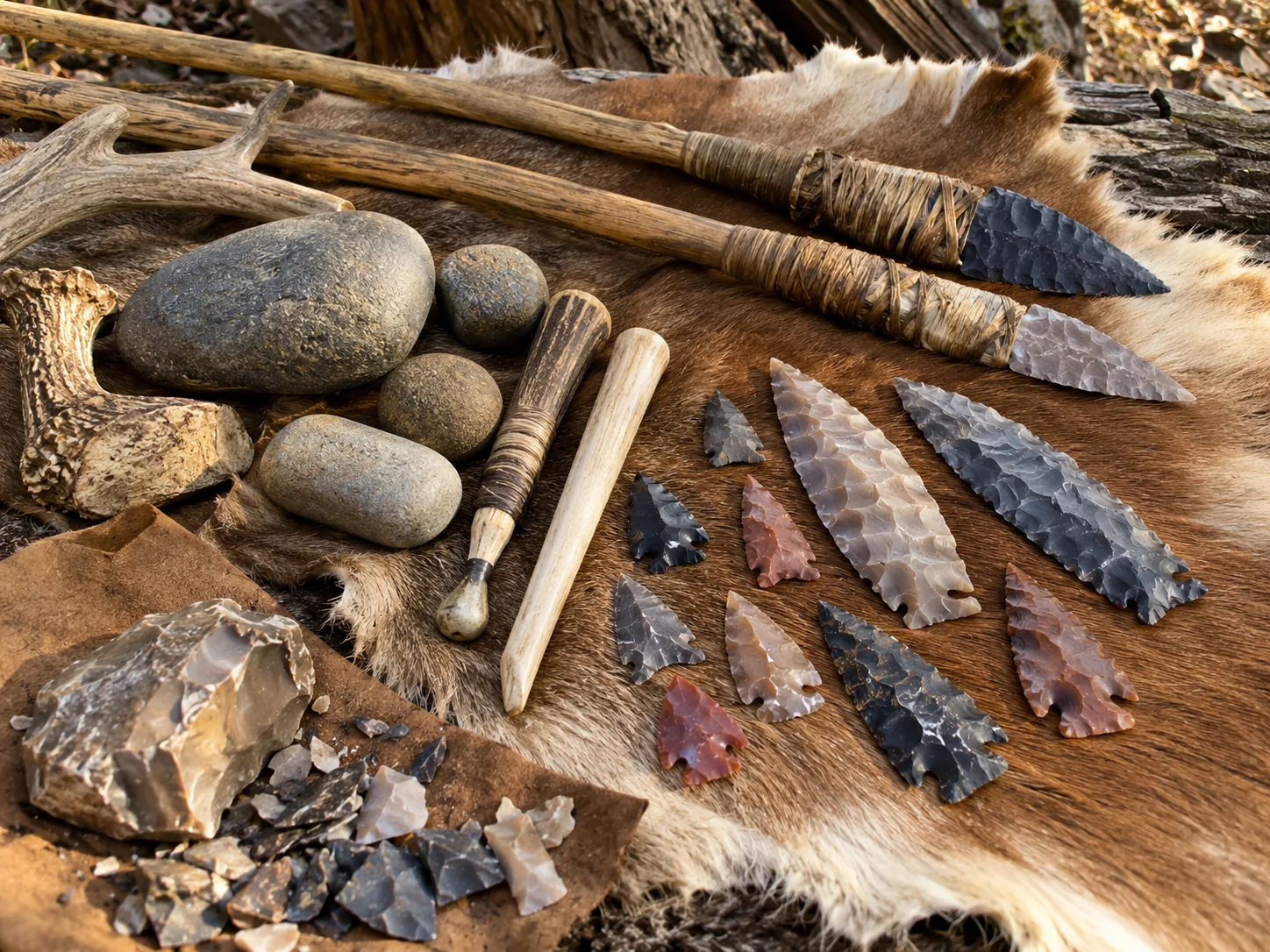
About the images: Illustrative scenes accompany this personal story. AI-created images are identified in their captions; they are not photographs of the encounters described.
The artist made it look so easy.
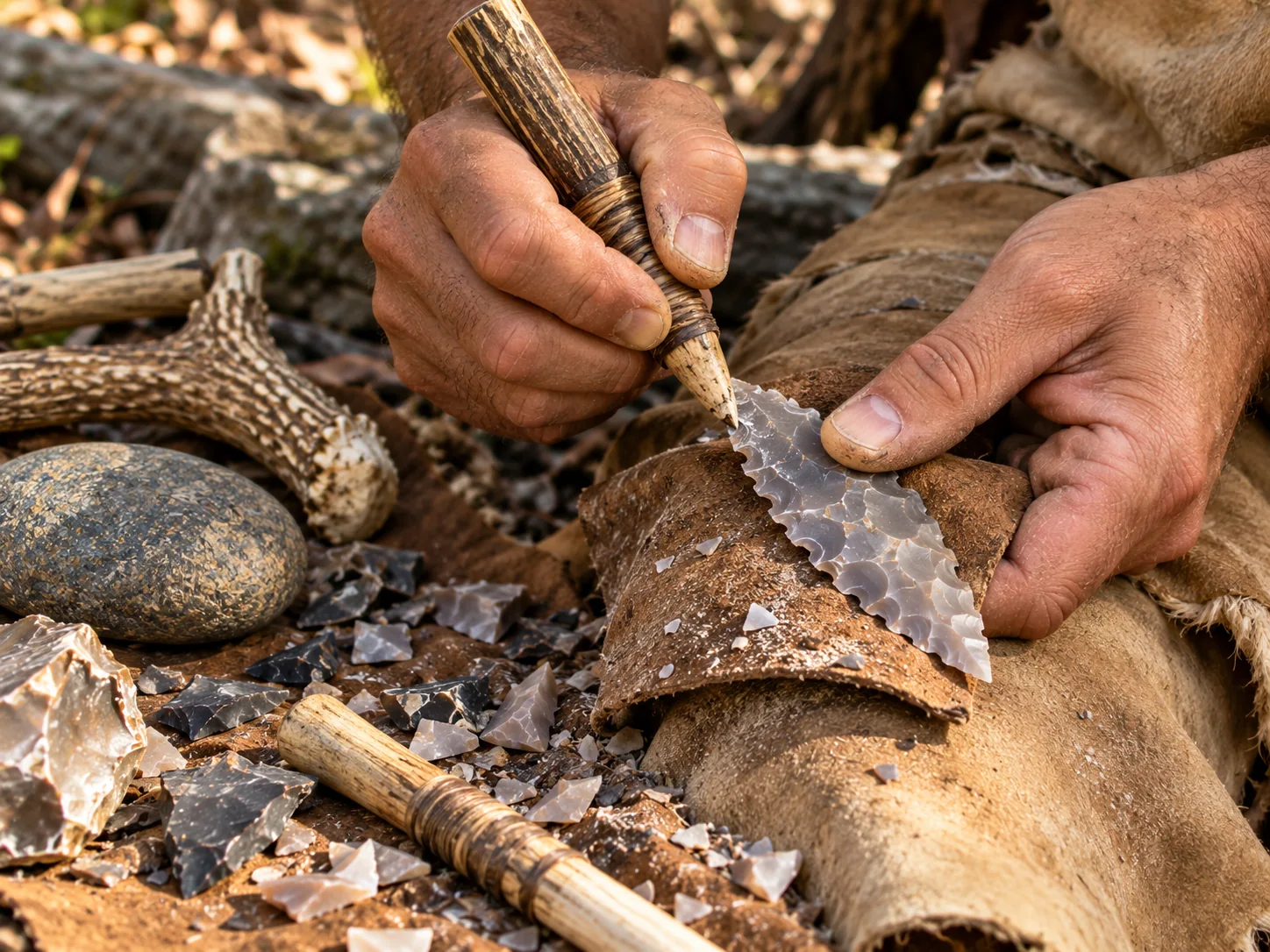
With quick, precise movements, he carefully removed pieces of stone, gradually revealing the shape of an arrowhead.
There was something fascinating about watching him work. Every movement seemed deliberate. He knew exactly where to apply pressure, where the stone would break, and how much material needed to come off.
At least, that’s how it appeared to me.
Because when I tried breaking chert myself, I discovered something.
Breaking a rock is one thing. Controlling exactly how it breaks is something entirely different.
And that little discovery gave me a whole new appreciation for an ancient craft called flintknapping.
A Discovery Along My Rockhounding Journey
I’ve always enjoyed rockhounding. There’s something exciting about exploring an area, searching through stones, and discovering something unusual that nature created.
Along that journey, I became interested in flintknapping, the art of shaping stone into tools by carefully removing flakes from its surface.
I had seen examples of the craft in different places, including watching an artist demonstrate arrowhead making at a craft festival.
What impressed me wasn’t simply the finished arrowhead.
It was the artist’s ability.
His movements were swift and precise, almost effortless. What appeared to be a rough piece of stone slowly became a carefully shaped object.
I knew it had to require skill, but I didn’t fully appreciate how much until I tried working with chert myself.
I didn’t have the specialized tools used by flintknappers. I was simply curious about how the stone would break.
And I quickly discovered that making a stone fracture wasn’t the difficult part.
Making it fracture where I wanted was another story!
Watching someone who has mastered a craft can make you forget just how much practice, patience, and understanding went into developing that ability.
That experience reminded me that there’s often a tremendous difference between watching someone do something and trying it yourself.
An Art Older Than Civilization
One of the most remarkable things about flintknapping is how far back its history reaches.
Long before people learned to work with metal, our distant ancestors were making cutting tools from stone.
Some of the earliest Oldowan stone tools date to around 2.9 million years ago, and archaeologists have discovered even older stone artifacts dating to around 3.3 million years ago.
Think about that for a moment.
Millions of years before modern workshops, steel blades, or even the earliest civilizations, ancient toolmakers were discovering how to shape stone into something useful.
Stone tools helped people cut meat, process plants, prepare materials, and perform countless tasks necessary for survival.
Over immense stretches of time, toolmaking techniques became increasingly sophisticated.
Some early tools were little more than stones with a sharp edge.
Others eventually became beautifully shaped projectile points, knives, scrapers, and specialized implements.
And what fascinates me is that these weren’t simply objects someone picked up off the ground.
They were intentionally made.
Someone had to understand the material, plan the shape, and carefully remove pieces without destroying the entire tool.
The more I learned about that process, the more impressive those ancient artifacts became.
The Secret Is in How the Stone Breaks
Here’s something I found particularly interesting.
Flintknapping isn’t really carving in the way we might carve wood.
Instead of shaving material away, the craftsperson removes flakes through carefully controlled fractures.
Certain materials, including chert, flint, and obsidian, have a special characteristic called conchoidal fracture.
That’s a scientific term describing the curved, shell-like patterns that can form when these materials break.
Rather than splitting along predictable layers or grains, they can produce sharp-edged flakes when force is applied in the right way.
An experienced flintknapper understands how to take advantage of this behavior.
The angle of the strike, the location of the impact, the shape of the stone, and the amount of force all influence the result.
And every flake removed changes the shape of the material, affecting what can happen next.
That explains something I noticed while watching the artist.
His movements weren’t random.
He was working through a sequence of decisions, constantly responding to the shape of the stone.
And if a fracture travels somewhere unexpected, it can ruin the intended shape or break the piece entirely.
Suddenly, the patience involved becomes much easier to appreciate.
The Tools Behind the Craft
Traditional flintknapping often involved using one stone to strike another, along with tools made from materials such as antler or bone.
Modern flintknappers may use hammerstones, copper-tipped tools, antler billets, and specialized pressure-flaking tools.
Two important techniques are percussion flaking and pressure flaking.
Percussion flaking uses a controlled strike to remove a flake.
Pressure flaking uses steady force applied near an edge to remove smaller flakes, often allowing the craftsperson to refine the final shape.
It sounds simple when you describe it.
But watching an experienced artist makes you realize how much knowledge is involved.
There’s an understanding of angles, pressure, material quality, and the way fractures travel.
And perhaps most importantly, there’s patience.
A finished arrowhead might look like a small, simple object.
But every edge and every carefully removed flake represents a decision.
The Arrowhead Made from a Glass Bottle
Now here’s where my fascination with flintknapping took an unexpected turn.
On another occasion, I watched a different artist working with a material I never would have associated with making arrowheads.
Broken glass.
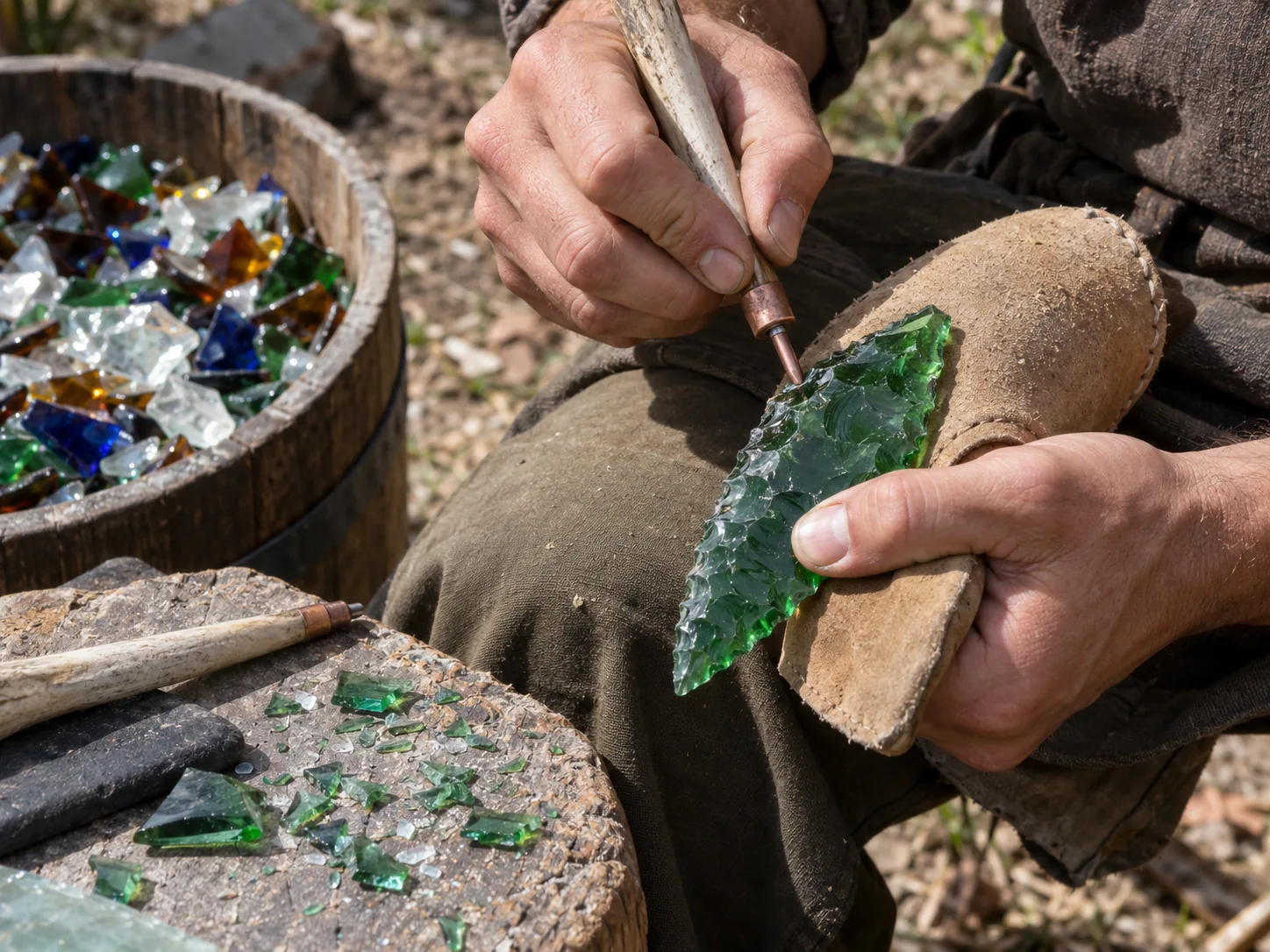
He had a barrel full of glass pieces, and I remember watching him select what appeared to be the bottom of a wine bottle.
I was amazed.
Here was someone taking something most people would throw away and using it to create an arrowhead.
Until then, I had associated flintknapping with particular types of stone.
I knew chert, flint, and obsidian were used because of how they fracture.
But an ordinary glass bottle?
That blew my mind!
As it turns out, glass can fracture in much the same way as those fine-grained stones.
In fact, obsidian is a naturally occurring volcanic glass.
Both obsidian and manufactured glass can produce extremely sharp edges when fractured.
The artist didn’t need an ancient piece of stone or some rare material.
He needed something that would fracture appropriately—and the knowledge to shape it.
I found that remarkable.
A broken bottle, something that might otherwise be considered worthless, could become a carefully crafted piece of art.
And it wasn’t the glass itself that made the transformation so impressive.
It was the skill of the person working with it.
More Than Just an Arrowhead
When we look at an ancient stone arrowhead in a museum, it’s easy to see it simply as an old object.
But I think there’s much more to appreciate.
Imagine the person who made it.
They had to find suitable material, understand how it behaved, and possess the skill to shape it into something useful.
That knowledge wasn’t developed overnight.
It was learned, practiced, refined, and passed from one generation to another.
And the finished object might have been essential to providing food or making other tools.
Today, flintknapping continues through traditional skills practitioners, artists, educators, archaeologists, and people who simply enjoy learning an ancient craft.
Some study the techniques to better understand how prehistoric tools were made.
Others create beautiful examples of craftsmanship, preserving skills that connect us to an extraordinary part of human history.
And there’s something I find especially meaningful about that connection.
The materials may have changed. The tools may have evolved. The reasons people practice the craft may be different.
But the relationship between the artist, the material, and the skill remains.
The Masterpiece Is in the Making
Looking back, I think what impressed me most about those two artists wasn’t necessarily the arrowheads they produced.
It was watching their understanding of the materials come to life.
One artist worked with stone, using precise movements to shape something that might have been made thousands of years ago.
The other reached into a barrel of broken glass and saw possibilities where I might have seen nothing more than discarded bottles.
Both demonstrated something I deeply admire.
Patience.
Creativity.
Knowledge.
And the ability to transform an ordinary material into something extraordinary.
My own attempt to break chert taught me just enough to understand how much I didn’t know.
And sometimes that’s one of the best discoveries we can make.
The more we understand what goes into creating something, the more we appreciate the hands that made it.
Join the Discovery
Here’s your next Discover the Journey challenge: Find the craftsmanship hiding in an ordinary object.
It might be a handmade knife, a piece of pottery, a wooden bowl, a carved stone, or something you’ve had in your home for years.
Take a closer look.
What materials were used? How might someone have shaped them? What skills would a person need to create that object?
Maybe you’ll discover a local craftsperson demonstrating a traditional skill. Maybe you’ll visit a museum and look at an ancient tool differently. Or perhaps you’ll find something handmade at a craft festival and take a moment to learn the story behind it.
I’d love to hear about your discovery!
Share a photograph, a story, or something interesting you’ve learned about how an object was made.
And if flintknapping sparks your curiosity, consider watching an experienced craftsperson demonstrate it. Fractured stone and glass can produce dangerously sharp edges and flying fragments, so hands-on learning requires proper instruction and protective equipment.
You don’t have to make something yourself to appreciate the remarkable skill involved.
Sometimes simply watching, asking questions, and paying attention can lead to an unforgettable discovery.
Share your discovery →Behind the Discovery
My interest in flintknapping developed through my adventures in rockhounding.
Over time, I became fascinated not only with the rocks and minerals I found, but also with what people could create from them.
I had the opportunity to observe flintknapping in several settings, including watching an artist make stone arrowheads at a craft festival.
His speed, precision, and patience left a lasting impression.
I even tried breaking chert myself, without specialized flintknapping tools, simply to experience how the material behaved.
That small experiment gave me a much greater appreciation for the skill involved.
On a separate occasion, I watched another artist work with broken glass. I remember the barrel of glass pieces and seeing him select what looked like the bottom of a wine bottle.
Discovering that an ordinary bottle could be transformed into an arrowhead was something I hadn’t expected.
Both experiences reminded me why I enjoy exploring and learning new things.
You never know when an ordinary material, an unfamiliar craft, or a conversation with someone who has mastered a skill will change the way you see the world.
Sometimes the most remarkable discovery isn’t the object itself.
It’s understanding what someone had to learn to create it.
What did you discover today?
Discover the Journey.