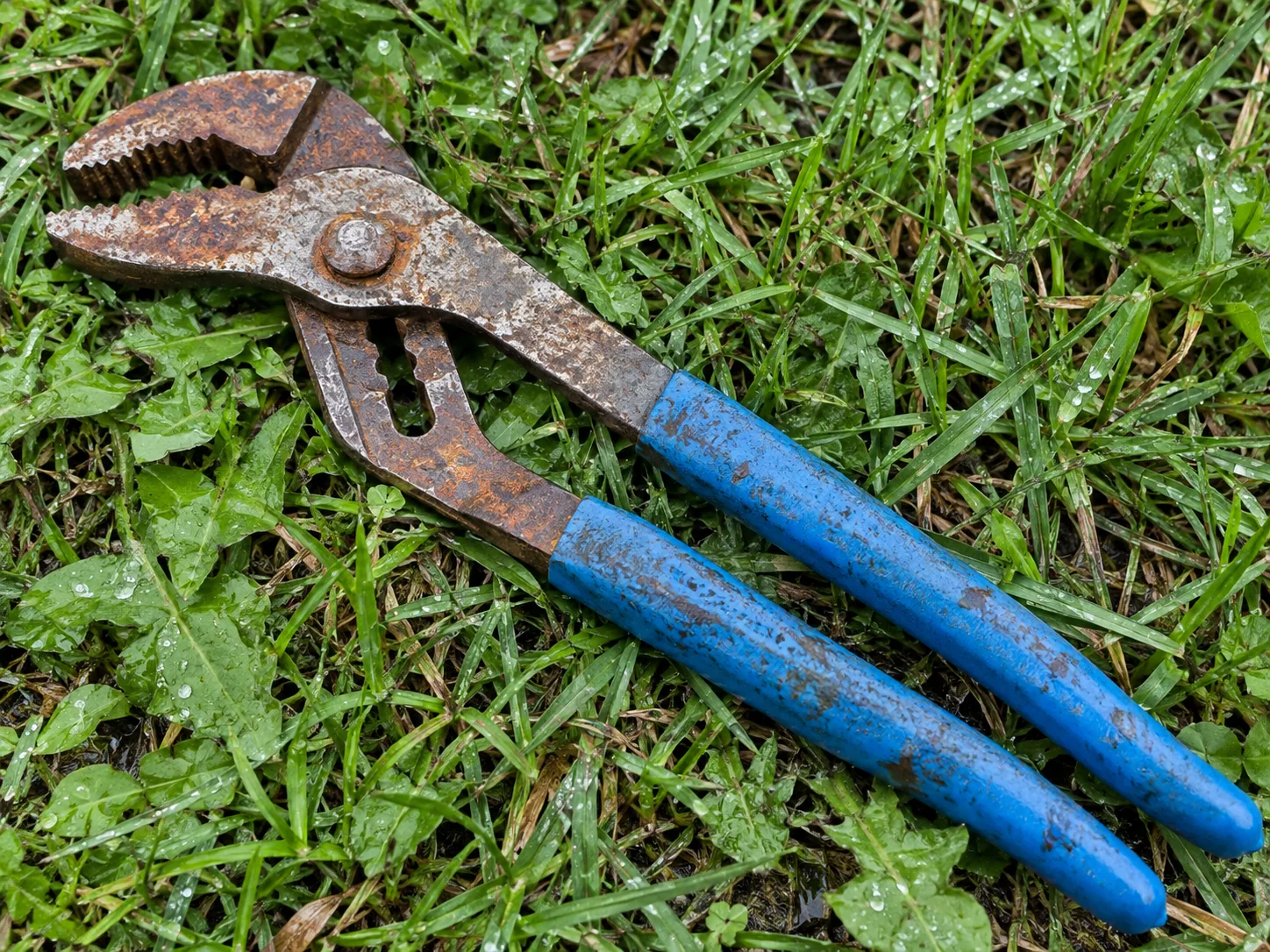
About the images: Illustrative scenes accompany this personal story. AI-created images are identified in their captions; they are not photographs of the encounters described.
I couldn’t believe it.
My favorite pair of channel-lock pliers had been left outside in the rain.
Just one time!
A few days later, there they were. Rusty, stiff, and looking nothing like the dependable tool I was used to reaching for.
Seriously? One rainy day, and now this?
I suppose I could have thrown them away and bought another pair.
But that’s never been my style.
I’ve always had a difficult time throwing things away, especially when I believe they might still have some useful life left.
In fact, when I see something that someone else has discarded, I often find myself wondering what I could do with it.
Could it be repaired? Restored? Repurposed?
Is there something worth saving underneath all that dirt, damage, or rust?
And when it comes to rusty metal, the answer can sometimes be surprisingly interesting.
Because removing rust isn’t just about scrubbing an old tool until it looks better.
It’s about chemistry.
And chemistry has always fascinated me.
What’s Actually Happening When Metal Rusts?
We all recognize rust.
That reddish-brown coating that appears on old tools, fences, bolts, and other metal objects.
But what exactly is it?
Rust is the result of a chemical process called corrosion.
When iron or steel is exposed to oxygen and moisture, electrochemical reactions can begin changing the metal into iron oxides and related compounds.
The process involves the movement of electrons and a series of reactions between iron, oxygen, and water.
The result is the flaky, reddish-brown material we recognize as rust.
Here’s something I found particularly interesting.
Rust isn’t simply dirt sitting on the surface of metal.
It’s evidence that the metal itself has undergone a chemical change.
And unlike some protective surface coatings that form on other metals, ordinary rust doesn’t create a reliable barrier that prevents further corrosion.
Moisture and oxygen can continue reaching the metal underneath.
That’s why an old tool can gradually become rough, pitted, weakened, or even unusable.
But here’s the encouraging part.
A rusty tool isn’t necessarily a ruined tool.
Sometimes the corrosion is mostly on the surface, and much of the original metal is still intact.
That’s when understanding a little chemistry can make all the difference.
My Rusty Pliers and a Little Kitchen Chemistry
When I think about rust removal, I often think about my channel-lock pliers.
I hated the idea of giving up on a perfectly good tool simply because it had been left out in the rain.
Vinegar and baking soda are two familiar household substances I’ve used while dealing with rust.
And there’s some interesting science behind them.
Vinegar contains acetic acid.
Acids can react with rust and help loosen or dissolve corrosion products, making them easier to remove.
Baking soda, on the other hand, is mildly alkaline.
It can help neutralize residual acid after a vinegar treatment.
But here’s a little chemistry surprise.
If you mix vinegar and baking soda together, they react with each other, producing carbon dioxide gas.
That’s what creates all those familiar bubbles!
It certainly looks impressive.
But the fizzing doesn’t mean the mixture is magically eating away rust.
In fact, combining the two from the beginning neutralizes much of the vinegar’s acidity, reducing its ability to dissolve rust.
Sometimes understanding what a chemical reaction is actually doing is more useful than watching how dramatic it looks.
And vinegar isn’t the only way to deal with corrosion.
Not even close.
Different Ways to Fight Rust
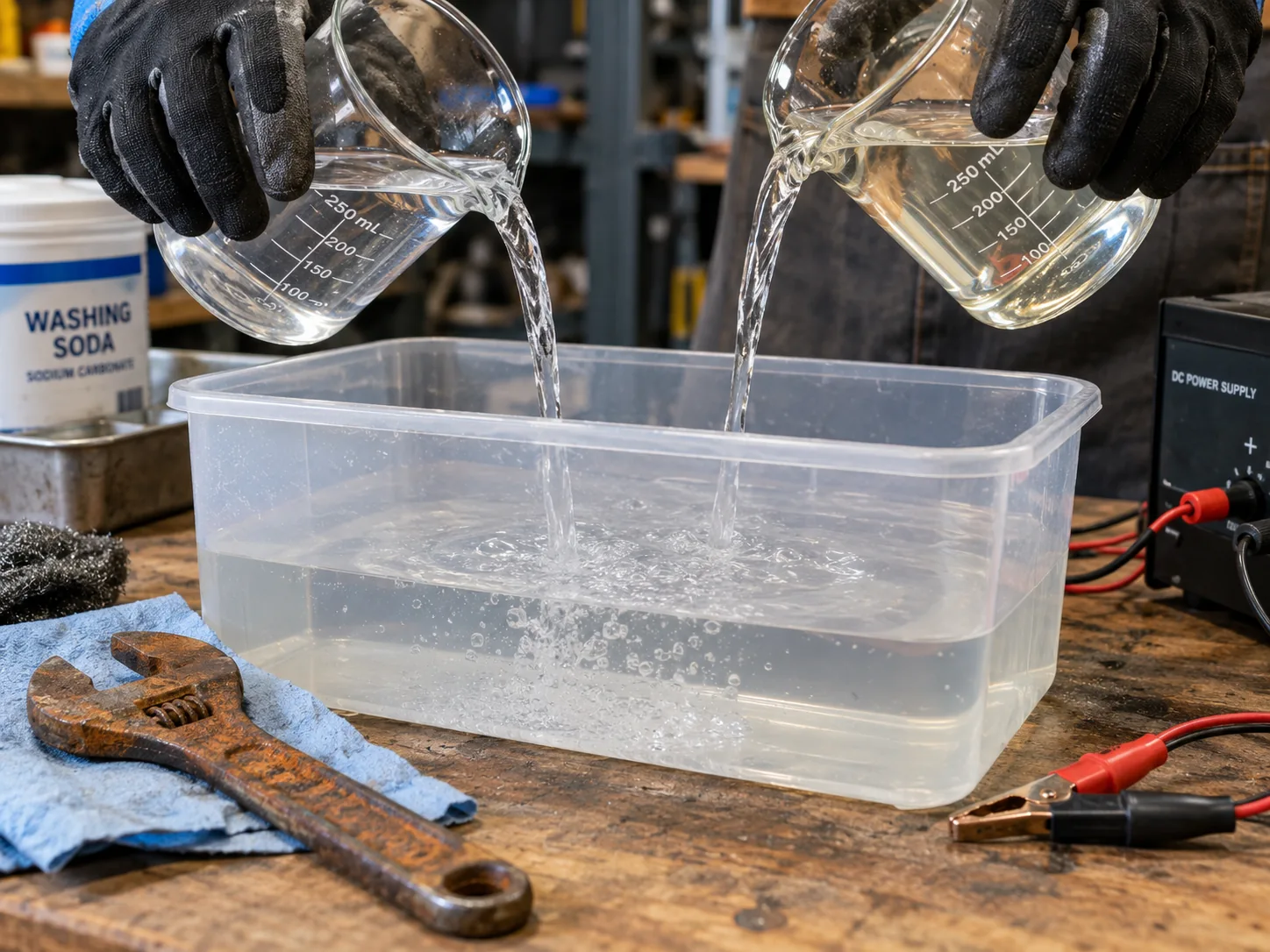
As I explored rust removal, I discovered that there are several approaches.
Some use chemistry.
Others use physical force.
And one particularly fascinating method uses electricity!
1. Vinegar and Mild Acids
Vinegar is probably one of the most familiar household approaches to removing rust.
Its acetic acid can help dissolve corrosion, particularly on small iron or steel objects.
Citric acid, a compound naturally found in citrus fruits, is another option used in rust removal.
Both can help loosen corrosion, although they work differently depending on concentration, temperature, exposure time, and the condition of the metal.
One important thing to understand is that acids don’t necessarily stop attacking a surface once the rust is gone.
They can also damage the underlying metal.
That’s why stronger isn’t always better.
2. Wire Brushes and Abrasives
Sometimes the simplest approach is mechanical removal.
Wire brushes, abrasive pads, sandpaper, and other tools physically remove loose rust from a metal surface.
This can be useful when dealing with sturdy tools and hardware.
But there’s a trade-off.
Aggressive cleaning can scratch the metal, remove original finishes, or erase markings.
On an ordinary working tool, that might not matter much.
On an antique or collectible object, it could matter a great deal.
And that brings up an interesting question.
Are we trying to make something look new, or are we trying to preserve its history?
Those aren’t always the same goal.
3. Electrolysis: Removing Rust with Electricity
Now this one really caught my attention.
Electrolysis uses electrical current to drive chemical reactions.
In certain restoration setups, a rusty iron or steel object is placed in a conductive solution and connected to a direct-current electrical system.
The reactions occurring at the metal surface can help loosen corrosion and change some of the compounds present.
It’s a fascinating example of electricity and chemistry working together.
Instead of relying entirely on scrubbing or acid, the restorer uses an electrochemical process to help separate corrosion from the remaining metal.
But electrolysis isn’t appropriate for every object, and it isn’t something to improvise casually.
Improper setups can create electrical hazards, damage objects, or generate dangerous gases. Certain metals and unsuitable solutions introduce additional risks.
For me, the remarkable discovery is simply that electricity can become a tool for restoring metal.
Who would have thought?
4. Commercial Rust Removers
There are also specially formulated products designed to remove rust.
Some rely on acids.
Others use compounds called chelating agents.
Chelating agents can bind certain metal ions, helping lift or dissolve corrosion through chemical interactions.
Different products work in different ways, so the instructions and material compatibility matter.
I find this especially interesting because two products might both claim to remove rust while relying on entirely different chemistry.
It’s a reminder that understanding the process can help us make better decisions about the tools and materials we use.
5. Rust Converters
Here’s another approach that surprised me.
Sometimes the goal isn’t to remove every trace of rust.
It’s to chemically transform certain corrosion products into a surface that can be prepared for a protective coating.
Some rust converters use phosphoric acid or other reactive ingredients.
These products are often used on metal structures, equipment, or surfaces that will eventually be painted.
They aren’t a universal solution, and they’re not necessarily appropriate for precision tools, moving parts, or valuable antiques.
But they demonstrate another interesting idea.
Sometimes restoration isn’t about removing a problem completely.
It’s about understanding how to stabilize what’s there.
Chemistry Is Everywhere
One reason this subject interests me so much is that I’ve always been fascinated by chemistry.
As a nurse, I’ve seen how deeply chemistry is involved in the way the human body functions.
Our bodies depend on countless chemical processes every moment.
Oxygen transport, digestion, nerve signaling, maintaining the proper balance of fluids and electrolytes—chemistry is involved in all of it.
And then I walk into my workshop, pick up a rusty pair of pliers, and there it is again.
Chemistry.
Different materials, different reactions, different purposes.
But the same basic principles of matter, energy, and chemical change are at work.
I think that’s amazing.
We often imagine science happening in laboratories, with researchers wearing white coats and working with complicated equipment.
But science is happening in our kitchens, our gardens, our garages, and even on the tools we leave outside.
Sometimes all it takes is a little curiosity to recognize it.
Removing Rust Is Only Half the Battle
Here’s another important discovery.
Even if you successfully remove rust, the job isn’t necessarily finished.
Freshly cleaned iron or steel can begin corroding again when exposed to moisture and oxygen.
That means drying and protecting the metal are important parts of restoration.
Depending on the object and its intended use, people may apply a light protective oil, wax, paint, or another suitable coating.
I’ve used mineral oil as a protective treatment on metal tools.
It helps create a barrier between the metal and the surrounding environment.
Of course, different tools and mechanisms require different types of lubrication and protection.
A pair of pliers has different needs than an outdoor gate or an antique display piece.
And if rust has already removed too much material or weakened a critical component, cleaning won’t restore its original strength.
That’s another important lesson.
Removing rust doesn’t replace metal that’s already been lost.
Sometimes an object can be saved.
Sometimes it can be repurposed.
And sometimes it really has reached the end of its useful life.
Learning to recognize the difference is part of the process.
Trash or Treasure?
I’ve always been the kind of person who sees potential in things other people might throw away.
An old tool.
A piece of hardware.
A weathered piece of wood.
Something broken that might still have a purpose.
I’ll admit, this habit can sometimes make it difficult to get rid of things!
But I enjoy looking at an object and imagining what it could become.
There’s something satisfying about taking something neglected and giving it another chance.
And when you understand a little of the science involved, the experience becomes even more interesting.
You’re not simply cleaning away rust.
You’re learning why it formed, how different treatments interact with it, and what you can do to protect the remaining material.
The transformation is rewarding.
But so is the discovery.
And sometimes, the knowledge you gain while trying to save one old tool becomes useful for dozens of future projects.
Join the Discovery
Here’s your next Discover the Journey challenge: Find Something Worth Saving!
Take a look around your garage, workshop, shed, or home.
Is there an old metal object you’ve been meaning to clean or repair?
Maybe it’s a rusty wrench, a pair of pliers, or an old piece of hardware.
Before throwing it away, take a moment to investigate.
What caused the corrosion?
Is the damage mostly on the surface?
What materials is the object made from?
Could it be safely restored, preserved, or repurposed?
Research the different restoration methods and learn why they work.
If you decide to try a simple project, choose a noncritical object, follow appropriate safety precautions and product instructions, and avoid combining cleaning chemicals. Wear suitable eye and hand protection, and remember that acids and electrical restoration methods have risks that require proper knowledge and equipment.
Don’t experiment on valuable antiques, unknown metal alloys, or safety-critical components.
And here’s another idea.
Take a before-and-after photograph!
I’d love to see what you discover.
Did you rescue something that looked beyond saving?
Did you learn something surprising about corrosion?
Or did you find an old object with a story worth preserving?
Share your photographs, experiences, and discoveries with Discover the Journey.
Sometimes the most rewarding projects begin with something someone else was ready to throw away.
Share your discovery →Behind the Discovery
This article grew out of my interest in repairing, restoring, and repurposing things.
I’ve always had a hard time throwing away something that might still have value.
Even when I see an object someone else has discarded, I often wonder whether there’s another use for it.
One experience that comes to mind is discovering that my favorite pair of channel-lock pliers had been left outside in the rain.
After only a short time, they had developed rust and become stiff.
It was frustrating to see a dependable tool in that condition.
But it also reminded me why I enjoy learning about restoration.
I’ve explored familiar substances such as vinegar and baking soda, along with mechanical cleaning and protective oils, while learning about different approaches to rust removal.
What interests me isn’t just making something look better.
It’s understanding what’s happening.
Chemistry has fascinated me for years, especially through my experience in nursing, where the importance of chemical processes becomes apparent in so many aspects of human life.
And I love discovering those same scientific principles at work in ordinary situations.
A rusty tool might not seem like the beginning of an adventure.
But when curiosity leads you to explore chemistry, history, craftsmanship, and the satisfaction of giving something a second chance, it becomes something much more interesting.
Sometimes the difference between trash and treasure is simply recognizing the potential that remains.
What did you discover today?
Discover the Journey.